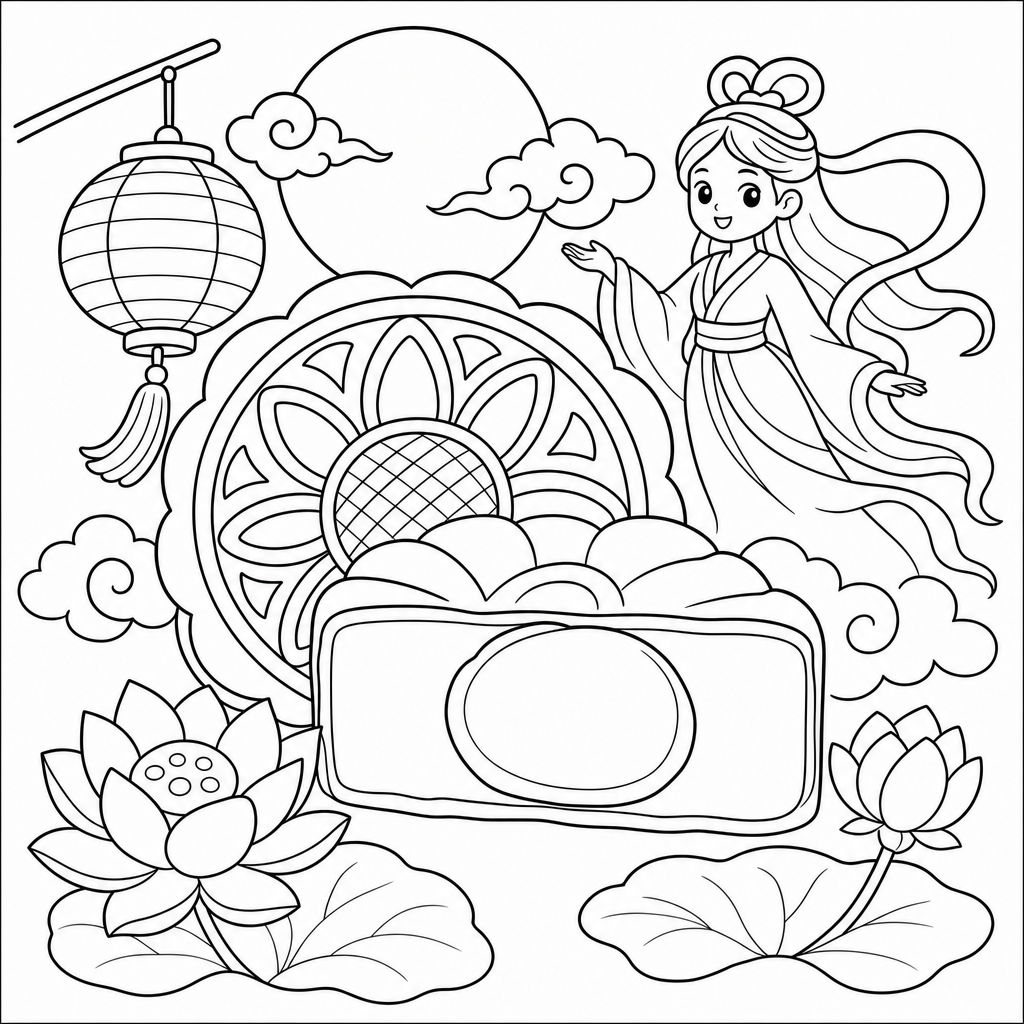
Mooncake scene
Free printable Mid-Autumn Festival coloring pages for kids with mooncake, rabbit lantern, and Chang'e with the jade rabbit.
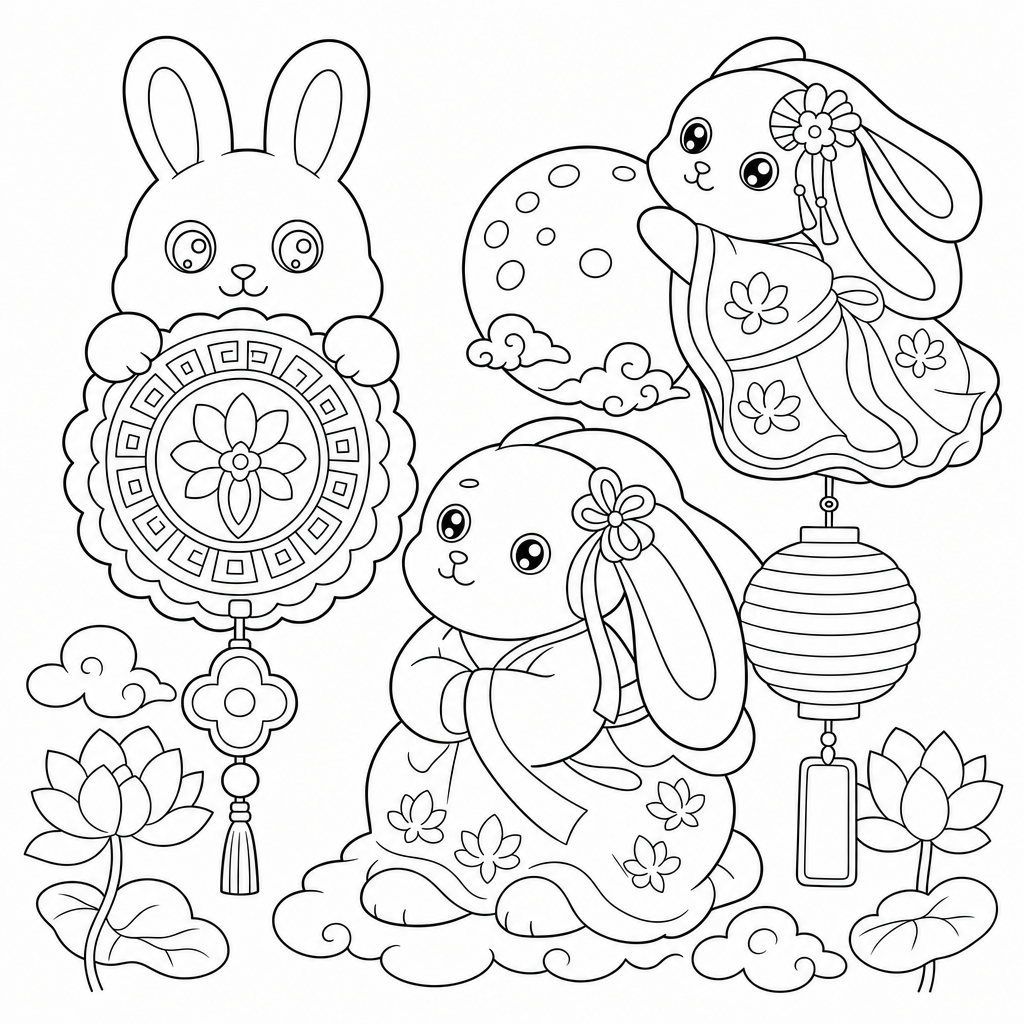
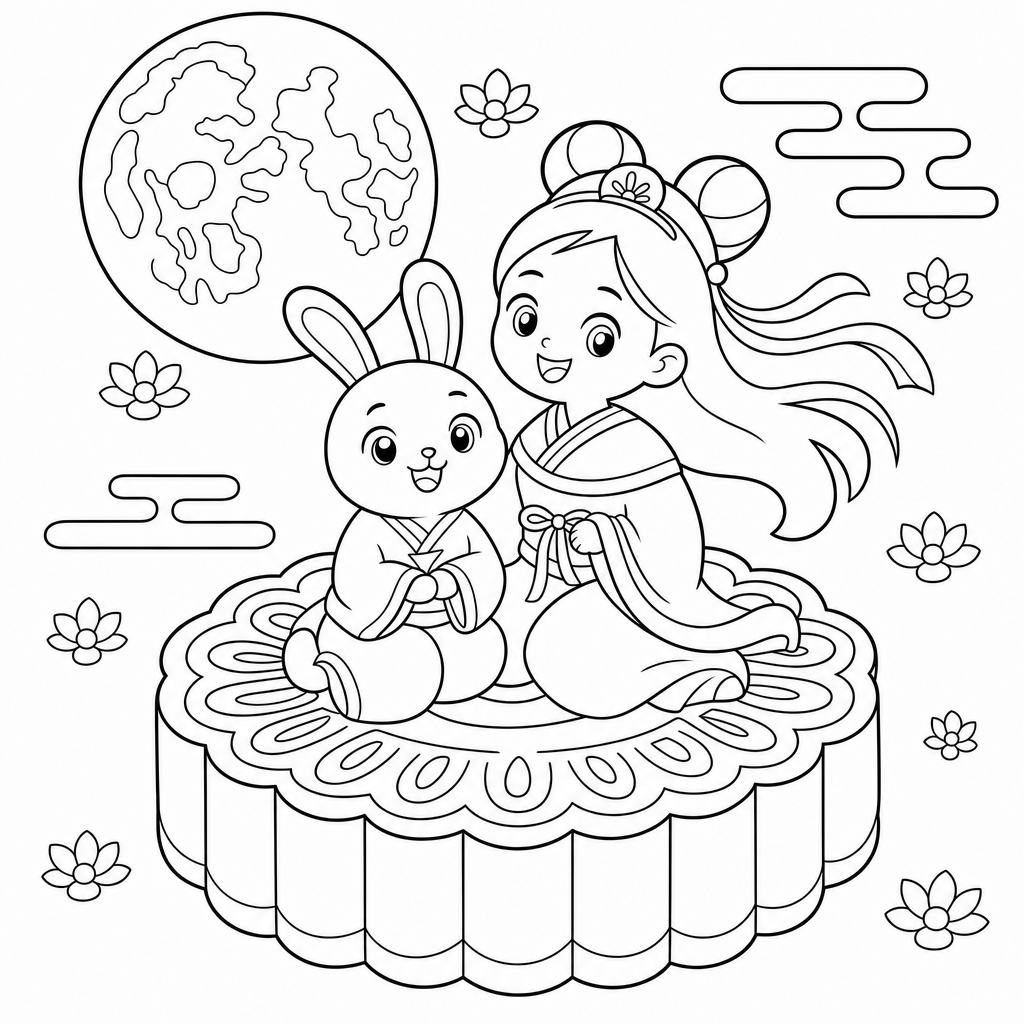
Three printable Mid-Autumn Festival coloring pages to start: a traditional mooncake scene with Chang’e and lanterns, a rabbit paper lantern page with three bunnies and lotus flowers, and Chang’e the moon goddess with the jade rabbit. Every page is hand-drawn line art, sized 8.5×11 at 300 DPI, optimized for crayons, markers, or colored pencils. Pages download instantly — no email signup, no ads, no spam.
The Mid-Autumn Festival (中秋节, Zhōngqiū Jié) is the second-biggest festival in Chinese culture after Lunar New Year, and one of the most quietly beautiful holidays of the year. It falls on the 15th day of the 8th lunar month — the night when the full moon is biggest and brightest. Families gather, eat mooncakes, light paper lanterns, look up at the moon, and tell the story of Chang’e the moon goddess and her companion the jade rabbit. In 2026, the festival is Friday, September 25.
If you’re an Asian-American parent who wants your kid to grow up with this festival instead of merely hearing about it once at school, these coloring pages are a small daily entry point. Color the mooncake page in the week leading up to Sept 25, hang it on the fridge or window. Color the rabbit lantern page on the day of the festival, then go outside and look at the actual moon together. Color the Chang’e page if your kid has more attention span — and tell them the myth while they color.
Mid-Autumn has a lot of imagery — mooncakes, lanterns, the moon, Chang’e, Hou Yi (her archer husband), the jade rabbit, Wu Gang (the woodcutter), pomelo, tea, family gatherings. We picked the three with the strongest signal for kids: a food symbol (mooncake), an object symbol (lantern), and a character symbol (Chang’e). Between them, a kid who finishes all three will have absorbed the visual core of the festival.
We’ll expand to more pages as Pinterest and PostHog signal which ones are landing — Hou Yi shooting down nine suns and the pomelo-fruit page are next in line.
A lot of Asian-American kids grow up adjacent to their heritage but not in it — they hear “we celebrate Mid-Autumn Festival” once a year, eat the mooncake their grandma sent, and that’s it. The festival doesn’t fully land because there’s no daily-life touchpoint between September of one year and September of the next.
Coloring pages aren’t the whole solution, but they’re a real one. A coloring page that lives on the fridge for a month around the festival gives a kid weeks of low-pressure exposure to mooncakes, lanterns, Chang’e, and the jade rabbit. By the time they’re old enough to actually read the myth, they already recognize every character in it. That’s how you build cultural fluency — not through a single annual moment, but through hundreds of small ones that add up over years.
This is the whole reason mamaki exists. Asian-American families deserve coloring content that’s actually researched (not “Asian-style” filler made by a generic AI), and we’re slowly building out the catalog so every major festival has at least three solid pages on it: Mid-Autumn this fall, Lunar New Year 2027 in late January, Dragon Boat Festival in June, Diwali in October.
The shapes are intentionally clean and the fill areas generous. Kids can also add their own background — Chang’e flying through clouds, a family eating mooncakes around a table, a city skyline under the full moon — to extend the page without competing with the line art.
There are several versions of the Mid-Autumn myth — every Chinese family has slight variations. Here’s the most commonly told one for kids:
Long ago, the sky had ten suns instead of one. They burned the earth so hot that crops died and people suffered. A great archer named Hou Yi climbed a mountain, drew his bow, and shot down nine of the ten suns one by one. He saved the world. As a reward, the gods gave Hou Yi a small bottle of elixir that could grant immortality.
Hou Yi had a wife named Chang’e, who was loving and gentle. He decided to give half the elixir to her so they could be immortal together, but a thief tried to steal it while Hou Yi was away. To keep the elixir from falling into the thief’s hands, Chang’e drank the entire bottle herself. She immediately became weightless and floated up into the sky.
She floated all the way to the moon, where she has lived ever since. The gods gave her a companion — a small white jade rabbit — who keeps her company by pounding the elixir of immortality with a mortar and pestle for eternity. On the night of the Mid-Autumn Festival, when the full moon is biggest and brightest, you can see Chang’e and the jade rabbit if you look carefully at the shadows on the moon’s surface.
That’s why Chinese families eat round mooncakes (round = full moon = reunion), why kids carry rabbit-shaped paper lanterns, and why the festival is a time for families to come together and look at the moon. The moon is where Chang’e is — and where everyone’s family lives, in spirit, even when they’re far apart.
For older kids, you can add the layer that the festival is fundamentally about reunion. In a country as large as China, families often live very far apart. The Mid-Autumn full moon is the same moon everyone in the family can see at the same time, no matter where they are. Looking at the moon together — even from different cities, different countries — is a way of being together when you physically can’t be. For Asian-American kids whose grandparents are in Asia, that framing tends to land emotionally.
Mooncakes are the festival’s signature food. A traditional mooncake is a round pastry about the size of a hockey puck, filled with sweet lotus paste and one to four salted egg yolks in the middle (the yolks represent the full moon). The top is stamped with an intricate pattern — usually flowers, characters meaning “longevity” or “harmony”, or the name of the bakery.
Modern mooncakes come in many flavors: lotus paste, red bean, mixed nuts, taro, pandan, durian, snow-skin (uncooked, refrigerated, almost like mochi), even ice cream and chocolate. In Hong Kong and Singapore the snow-skin mooncakes are especially popular with kids — they’re sweeter and softer and don’t have the salted yolk. In Taiwan, pineapple-cake-style mooncakes are common. In Vietnam, the festival is called Tết Trung Thu and the mooncakes are slightly smaller and often pig-shaped or fish-shaped.
The reason families eat round mooncakes is symbolism: round = full moon = full family reunion. The shape itself carries the meaning of the festival. A kid coloring a mooncake page is, without realizing it, learning the visual language of “completeness” and “togetherness” in Chinese culture.
If you can, get your kid to taste at least one real mooncake during the festival week. Most Chinatowns and 99 Ranch / H Mart / T&T stores carry them by September. Cut the mooncake into small wedges so the salted yolk in the center is visible — kids are always surprised that there’s an egg yolk inside a dessert. That moment of surprise is the kind of small cultural memory that sticks.
The other big festival tradition is paper lanterns. On the night of the festival, kids carry brightly-colored paper lanterns through the streets — rabbit-shaped, fish-shaped, lotus-shaped, dragon-shaped, sometimes star-shaped or in the shape of the year’s zodiac animal. In Hong Kong, Victoria Park hosts a famous lantern festival every Mid-Autumn night with thousands of glowing lanterns. In Taiwan, smaller community parks host lantern-carrying parades. In Chinatowns across the US, Mid-Autumn lantern walks have become a community-building tradition.
The rabbit lantern specifically connects back to the jade rabbit. Kids carry rabbit lanterns to honor the rabbit on the moon — it’s the visual equivalent of saying “I see you up there.” Some lanterns are real candles inside (older, traditional), some are LED lights with batteries (modern, kid-safe). Either way, the experience of holding a paper lantern in the dark while looking up at the moon is one of the festival’s signature moments.
If you’re in the US and there’s a Mid-Autumn lantern walk in your nearest Chinatown, take your kid. The community gathering itself is the cultural lesson — a thousand families with paper lanterns under the same full moon is a memory that lasts.
If there’s no community walk near you, here’s a small home version that works: cut out the colored rabbit lantern page, glue it onto cardstock to stiffen it, attach a string and a flashlight inside, and let your kid carry it around the backyard at dusk on Sept 25. It’s not the same as Victoria Park, but it’s the start of the tradition for your family.
This is the kind of holiday that benefits from a small ritual. Here’s a low-effort version that works for most families:
That’s it. You don’t need to throw a big party. The point is consistency — every year, the same small set of rituals, and over time your kid will associate “fall, full moon, mooncakes, lanterns, family” as one connected idea. That’s how heritage gets passed down.
The festival isn’t just Chinese — it’s celebrated across most of East Asia and Southeast Asia, with regional variations:
For Asian-American families with mixed heritage, this regional variety can be a doorway. If you have Korean grandparents and Chinese grandparents, your family can celebrate Chuseok and Mid-Autumn as parallel traditions. The moon is the same.
If you’re raising a kid bilingual or trying to introduce heritage-language vocabulary slowly, the Mid-Autumn Festival is a good annual on-ramp because the words are concrete and visible. Print one of the coloring pages and write the word for the object next to its picture. Even kids who only have a few words of Mandarin or Cantonese can recognize yuèbǐng if they’ve colored a mooncake page enough times.
Mandarin (pinyin) — for families with a Mandarin background:
Cantonese (jyutping) — for families with a Hong Kong / Guangdong background:
If you’re a non-heritage parent who wants to introduce these words to your kid without committing to a full language program, just say the words next to the page while they color. Yuèbǐng — point at the mooncake. Dēnglong — point at the lantern. Over a few years of festivals, they’ll absorb a small vocabulary the same way they absorbed colors and animal names as toddlers.
The version above is the kid-friendly telling. There’s a darker, richer version that older kids (8+) often find more interesting once they’re ready for myths with moral complexity.
In the deeper telling, Hou Yi the archer becomes corrupted by his fame. After saving the world by shooting down the nine suns, he becomes a king — but a cruel one. He oppresses his people. Chang’e, who still loves him, can’t bear to see him gain immortality and rule cruelly forever. So when she drinks the elixir, it’s not just to keep it from a thief. It’s a quiet act of resistance — she chooses to take immortality away from her husband by taking it herself.
She floats to the moon not as a passive victim but as someone who made a difficult moral choice. From the moon, she watches over the world she sacrificed herself to protect. The jade rabbit pounds the elixir not as a meaningless eternal task but as a continuing gesture — making more medicine, in case the world needs it again someday.
For older kids, this is a richer framing. The festival isn’t just about reunion and mooncakes. It’s about the people who made hard choices so future generations could live in peace. That’s a thread of meaning that survives every retelling — even the cute paper-lantern-and-mooncake version your kid colors today carries a small echo of that older story.
You don’t need to tell the dark version every year. But if your kid is reading more independently and asking “why does Chang’e live on the moon?” — the deeper telling is there when they’re ready for it.
The Mid-Autumn story also contains an earlier myth that doesn’t always get told to American kids: how the world used to have ten suns, and how Hou Yi shot down nine of them.
The story goes: long ago, the sky had ten suns. They were brothers, and they took turns crossing the sky one at a time, keeping the earth warm and the crops growing. But one day they decided to come out all together, just for fun. The earth burned. Rivers boiled. Crops shriveled. Forests turned to ash. People hid in caves and waited for the suns to set, but the suns wouldn’t go down.
Hou Yi was the greatest archer alive. He climbed a high mountain, drew his bow, and shot the suns down one by one — nine times, nine arrows, nine suns falling out of the sky and turning into the rivers, mountains, and animals of the world. The tenth sun, frightened, hid behind a cloud and only came out when the world had cooled. That’s the sun we have today.
For younger kids, this is a fun “hero saves the world” prequel to the Chang’e story. For older kids who like fantasy, it’s a satisfying world-building moment — the same story explains both why the world is the way it is, and how the moon goddess got there. Both myths fit on a single coloring page if your kid is up for a project (Hou Yi with bow drawn, nine suns falling, one tenth sun in the corner) — that’s on our queue for the next expansion.
Kids who color the mooncake page often want to know what’s inside a real mooncake. The traditional fillings can be a quick parent-child food culture lesson. The five most common are:
Each variety has its own regional and family loyalty. Hong Kong families often defend the traditional Maxim’s lotus paste with double yolks. Mainland families often go for mixed nuts. Taiwanese families lean toward the smaller fruit-and-mochi style. Singaporean families pioneered the snow-skin durian flavor. None of these are wrong — Mid-Autumn is one of those festivals where the food traditions splinter regionally and that’s part of the charm.
When your kid is old enough to ask, the answer to “which mooncake is best” is honest: “depends on which one your family ate growing up.” That framing turns mooncake-tasting into a small annual cultural archaeology project — every year, try a new flavor, talk about which family or region it comes from.
Mid-Autumn Festival has a quiet emotional weight that hits different from Lunar New Year. Lunar New Year is loud, celebratory, future-facing — fireworks, red envelopes, new year’s wishes. Mid-Autumn is the opposite. It’s quiet, contemplative, present-facing. You sit with your family. You eat slowly. You look at the moon. You think about the people who aren’t with you.
For Asian-American families, that quietness often makes the festival emotionally heavier than the bigger holidays. Lunar New Year is fun, and your kid will love it whether or not they “get” the deeper cultural meaning. Mid-Autumn requires the deeper meaning to land — without the moon-gazing, the family-reunion theme, the soft melancholy of looking up at the same moon your grandparents are looking at across the ocean, the festival is just “eat a mooncake.”
That’s actually a feature, not a bug. Mid-Autumn is the festival that grows with your kid. A four-year-old colors the mooncake page and eats a mooncake. An eight-year-old learns the Chang’e story. A twelve-year-old understands the reunion theme. A twenty-year-old, calling home from college, feels the moon-gazing tradition for the first time as something they actually need. That arc of deepening meaning over a decade is the whole point of building heritage rituals early.
Print the page now. Color it with your kid this year. Do it again next year. By the time your kid is the one calling home from college, the ritual will feel like it’s always been there — because, for them, it will have.
A question that sometimes comes up for non-Asian parents using these pages: “is it okay for us to celebrate Mid-Autumn if we’re not Asian?”
The short answer is yes, if you do it with care. Mid-Autumn Festival is widely celebrated across East Asia and the Asian diaspora, and the underlying concepts (harvest, full moon, family reunion) are not exclusive to any one group. Many community lantern walks, school festivals, and Chinatown events are explicitly open to everyone.
The thing to avoid is the generic version — the “Asian-style” lantern with no thought to what it actually is, the “Chinese princess” costume that conflates a thousand years of dress, the “fortune cookie” assumption (fortune cookies are American, not Chinese). The pages on this site exist precisely as the antidote to that. The mooncake is a real mooncake. Chang’e wears hanfu. The jade rabbit is the jade rabbit, not a generic bunny in a kimono.
If you’re a non-Asian parent celebrating Mid-Autumn because your kid has Asian friends at school, or because you love the holiday, or because you want your kid to grow up in a multicultural world — that’s cultural participation, and it’s welcomed. Show up. Eat the mooncakes. Learn the names. Tell the story right. That’s how a holiday stays alive across cultures.
Hand-drawn fan-art line art created with cultural research, optimized for printing on a home printer. For personal and classroom use only — please don’t sell prints.
The Mid-Autumn Festival is a public-domain cultural tradition shared across East Asia and the Asian diaspora. These pages are our small contribution to keeping it alive in kid form for the families who celebrate it, and our gentle introduction for the families who haven’t yet but want to start.
If your kid loves the festival, real mooncakes from a real bakery, a real paper lantern, and a real Mid-Autumn night under a real moon will always beat a printed page. The page is the start. The festival is the destination.
Instant-download a 25-page printable pack, or gift the custom storybook bundle starring your kid plus a matching printed coloring pack.