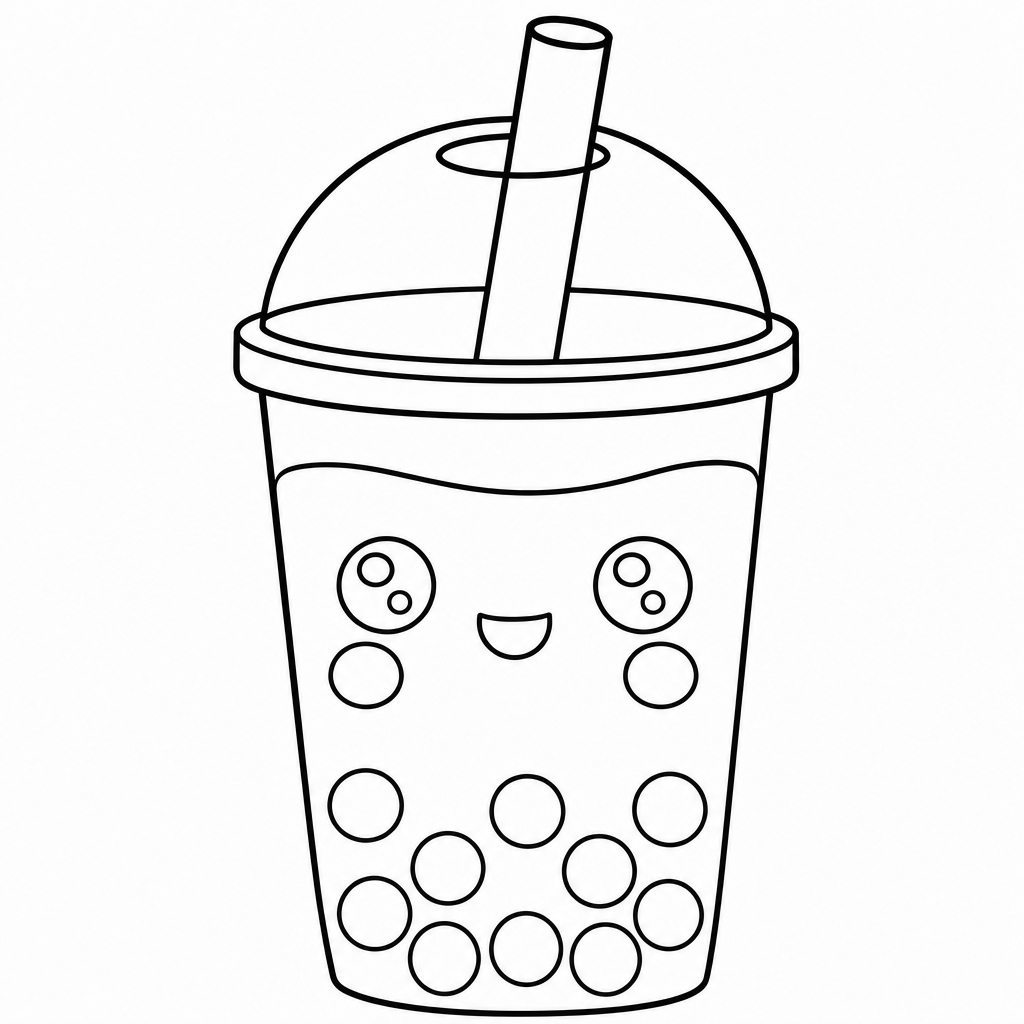
Classic milk tea
Free printable boba coloring pages for kids with milk tea, taro, and matcha cups, kawaii faces, tapioca pearls, and 8.5x11 line art.
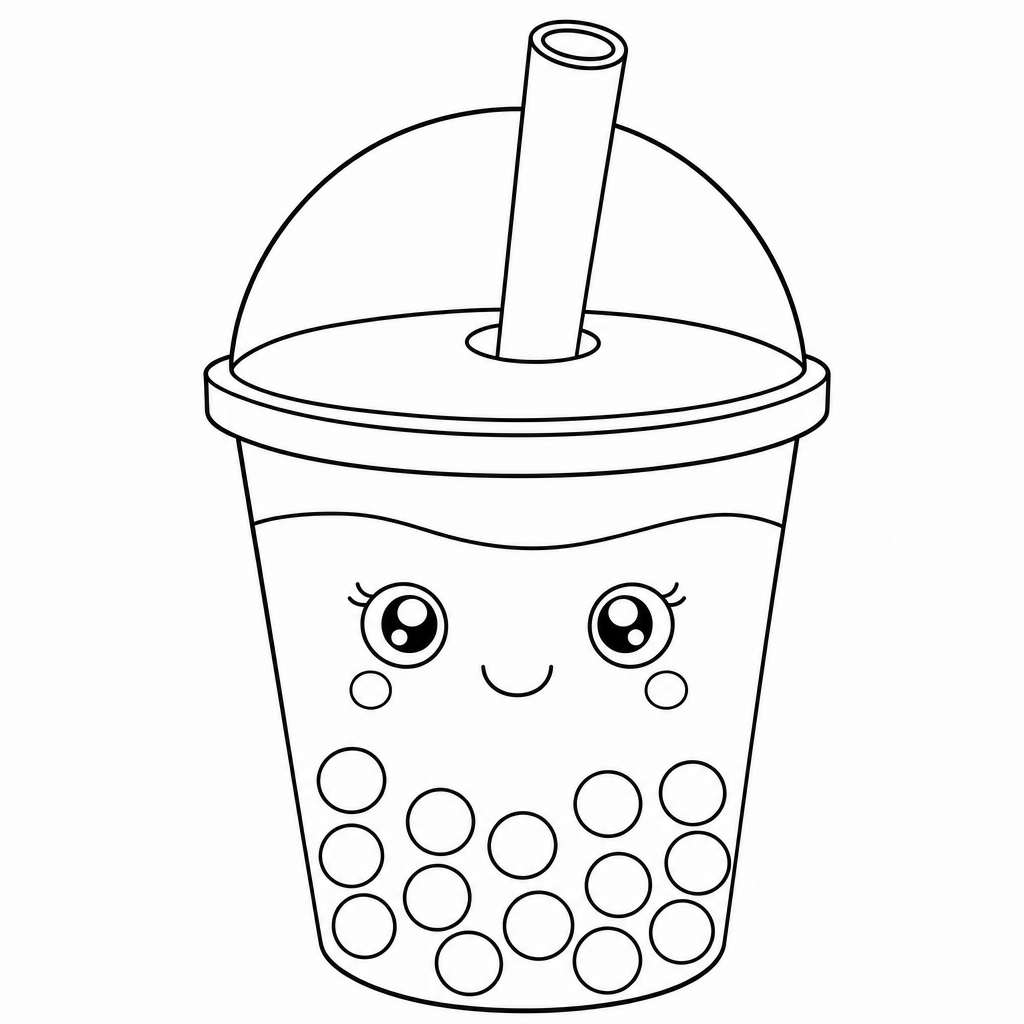
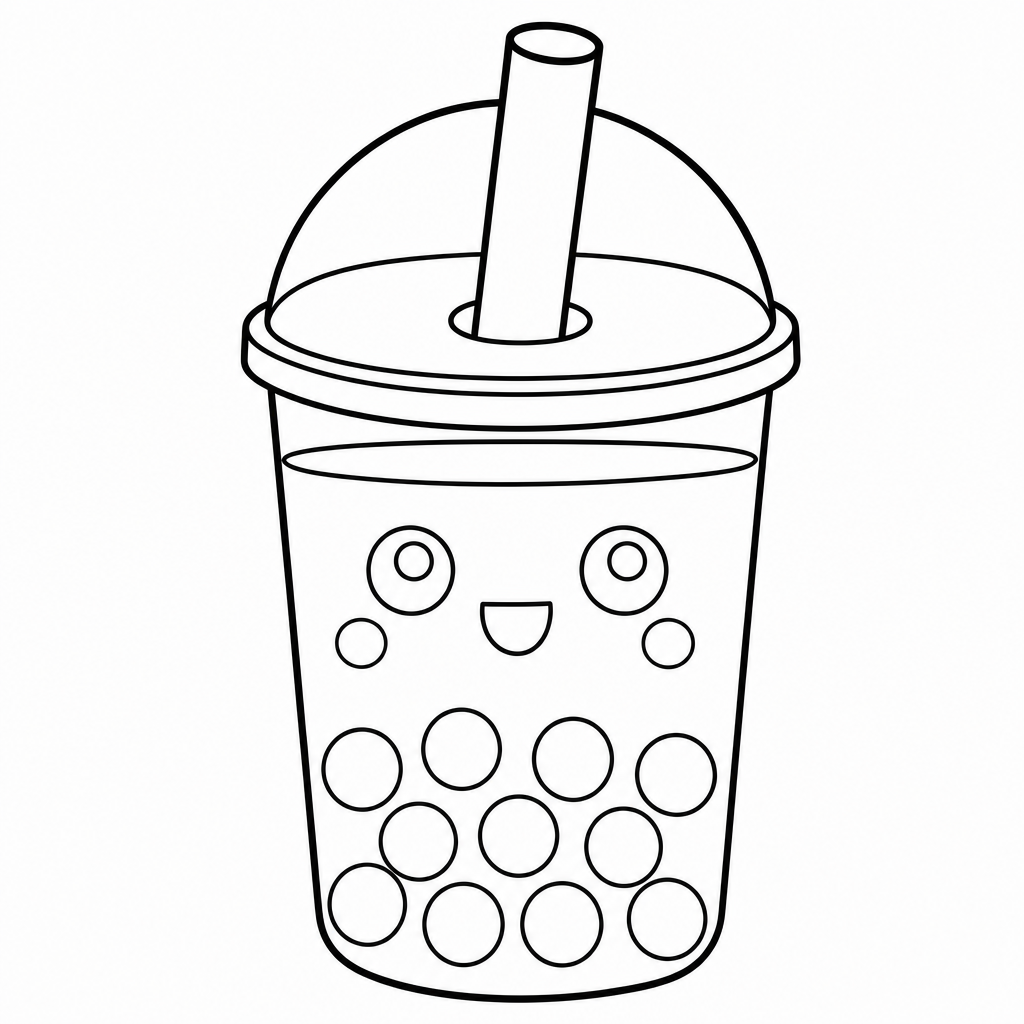
Three printable boba coloring pages to start: a classic milk tea boba cup, a taro boba cup, and a matcha boba cup. Every page is hand-drawn line art with a friendly kawaii face on the cup, a domed lid, a wide-bore straw, and tapioca pearls drawn as individual open circles big enough to color one pearl at a time. Pages are sized 8.5×11 at 300 DPI, optimized for crayons, markers, or colored pencils. Downloads are instant — no email signup, no ads, no spam.
Boba (also called bubble tea, pearl milk tea, or in Mandarin zhēn zhū nǎi chá 珍珠奶茶) is the unofficial drink of Asian-American childhood in the 2020s. If you grew up in Cupertino, the San Gabriel Valley, Flushing, Bellevue, Rowland Heights, Plano, or any other diaspora hub, you remember when your local strip-mall got its first Lollicup or Quickly — and how, twenty years later, every kid you know has a regular order. Classic milk tea with regular ice and half sugar. Taro milk with no ice and extra pearls. Matcha latte, light sweet, no foam. These are not random preferences. These are identities.
These coloring pages are a small love-letter to that. Print them, color them with your kid, and the next time they order a real boba they’ll have a little extra context for what’s actually in the cup.
Boba has fifty flavors in any decent shop — milk tea, taro, matcha, Thai tea, strawberry, mango, peach, jasmine, oolong, brown sugar, lychee, passionfruit, honeydew, ube, black sesame, and so on. We picked the three with the strongest signal for kids who are just learning the boba menu:
Between these three, your kid has the visual core of the boba menu. Strawberry, Thai tea, and brown-sugar pages are queued for the next batch.
A lot of Asian-American kids grow up near their heritage without fully being in it. They know “we’re Taiwanese” or “we’re Chinese-Vietnamese” or “we’re Korean,” they eat the food their parents cook, they go to the boba shop on Friday after school, and that’s basically the whole experience. The deeper version — the Taichung origin story of boba, the Hokkien word pô-pa for “small pearl,” the cultural reason every Asian-American suburb has a milk-tea shop next to a hot-pot restaurant — doesn’t quite get passed down because no one explains it.
Coloring pages are a small but real entry point. A boba page on the fridge for a week means the next time the kid sees a boba shop on a road trip, they recognize the cup silhouette instantly. The next time a parent says “do you know boba comes from Taiwan?” the kid has somewhere to attach that fact. Heritage doesn’t transmit in a single big talk — it transmits in dozens of small moments, and a coloring page on a Tuesday afternoon is one of the easiest small moments to manufacture.
This is the same reason we build the Mid-Autumn, Diwali, and Lunar New Year pages. Festivals are once a year; food is every week. The boba page is the everyday-heritage entry, and the festival pages are the holiday-heritage entries — together they cover the whole calendar.
Kids love adding their own touches: writing their custom boba order in the white space (“matcha 50% sugar light ice extra pearls please”), drawing extra pearls in a swarm around the cup, adding bubbles around the rim, or sketching a friend’s boba cup beside their own. Encourage it. Every extra mark a kid adds is a small step toward making the page their own.
Here’s the version of the boba story to tell your kid while they color:
Long ago — well, in 1988, which is long ago to a seven-year-old — there was a teahouse in Taichung, Taiwan called Chun Shui Tang (春水堂). The owner, Liu Han-Chieh, had recently visited Japan and seen how the Japanese served iced coffee. He started serving cold tea in his own shop, which was a small revolution; Taiwanese tea had always been served hot.
One slow afternoon, a product-development manager named Lin Hsiu Hui dumped her leftover tapioca-pudding dessert (粉圓 fěn yuán) into her iced milk tea on a whim during a staff meeting. Everyone laughed, drank it, and decided it was incredible. It went on the menu. Within months it was the most popular drink in the shop. Within five years it was the most popular drink in Taiwan. Within twenty years it was the most popular Asian drink on Earth.
(There’s a competing origin story from the Hanlin Tea Room in Tainan, which says they invented it around the same time with a different inspiration. Both stories are credible. Taiwan declared the question officially undecided after a ten-year lawsuit between the two shops, and the answer is basically: boba is from Taiwan, and you can visit either teahouse today and they’ll both still sell it to you.)
The drink spread from Taiwan to Hong Kong and Singapore, then to the United States via the Taiwanese diaspora in the early 1990s. The first wave of American boba shops opened in San Gabriel Valley, California (places like Lollicup, Tea Station, Quickly) and in Cupertino. The drink stayed Asian-American for about a decade before crossing over to the mainstream around 2015, and now there are an estimated 4,000+ boba shops in the US alone.
For a five-year-old, the headline version is plenty: “Boba was invented in Taiwan in 1988 by a lady who dumped her dessert into her tea.” That sentence alone is one of the better facts a kid can learn this week.
Boba is one of the easiest visual subjects for a kid to color. The shapes are simple — a tall cup, a domed lid, a straw, a bunch of circles. The colors are forgiving — boba can be any color in the rainbow (literally; matcha is green, taro is purple, Thai tea is orange, strawberry is pink, mango is yellow, blueberry is blue) and it all reads as “boba.” The kawaii face on each cup is endlessly customizable. There is no anatomy to get wrong.
This makes boba pages especially good for mixed-age sibling sessions. A four-year-old can color the classic milk tea cup in ten minutes flat. An eight-year-old can spend half an hour shading individual pearls in three different shades of brown. A ten-year-old can use colored pencils to create a real gradient from tan-on-top to darker-tan-near-the-pearls. Same page, three different attention spans, three different outcomes — all of them on the fridge.
Start with the classic milk tea page. The shapes are big, the fill areas are obvious, and the dark-pearl color is forgiving. Hand them three crayons — tan, brown, and one accent color of their choice — and let them go. Younger kids especially love coloring the kawaii face, which they will sometimes give wild expressions (one big eye, one small eye, a tongue sticking out, etc). All of this is fine.
For this age, the taro and matcha pages are also great because the colors are punchy. Purple and green are popular colors with kids in this age range, and a fully-colored taro or matcha cup looks like a real boba almost regardless of how messy the coloring is.
This is the sweet spot for the multi-pearl detail. Six- to nine-year-olds love filling in lots of small shapes — and the boba cup has 25–35 individual pearls to color. Give them a set of markers and they’ll spend thirty to forty minutes carefully coloring each pearl. Some kids will color them all the same color (canonical brown-black tapioca); some will color them in a rainbow pattern (which is non-canonical but adorable); some will color them in a gradient from light to dark. All approaches are correct.
This is also a great age to start the “design your own boba” prompt. Print the page, then ask the kid: if you were starting a boba shop, what flavor would you invent? Let them write the flavor name in the white space above the cup, color the cup that flavor, and announce the new drink to the family.
For older kids who can sit with a single page for an hour, the matcha or taro page is the page to lean into. Use colored pencils. Encourage gradient shading on the body of the drink (lighter purple or green at the top, deeper at the bottom near the pearls), highlight detail on the lid (slight curve, slight shadow underneath), and individually shaded pearls for visual depth. The result, with care, can look like a published illustration.
This is also the age where the storytelling around the pages lands. Tell them the Taichung origin story while they color. Tell them why tapioca pearls are called “boba” — the word literally means “big breasts” in Mandarin slang, which sounds vulgar but is actually how the larger pearls (1cm) got distinguished from the smaller traditional pearls (5mm), and is now just the accepted name for the whole drink category. Older kids think this is the funniest fact they’ve ever heard.
Coloring pages work best when paired with the real thing. Here’s one simple boba ritual that works for a lot of families:
Repeat this once a month and you’ve built a small family ritual that the kid will remember in their twenties — not because of the boba, but because of the consistency. Heritage is repetition. A boba shop once a year is a trip; a boba shop every month is a memory.
This page will grow. Next batch will add strawberry-milk boba (pink cup, strawberry slice on the rim, the most-Instagrammed boba flavor), Thai-tea boba (orange-cream layered cup, the boba flavor with the most distinctive look), and brown-sugar boba (caramelized stripes on the inside of the cup, the boba flavor everyone tried after the Tiger Sugar trend went viral in 2018). After that, we’ll add a boba shop counter scene with multiple flavored cups, a kawaii barista, a menu board on the wall, and a small kid at the counter pointing at her order.
We’re also planning a longer-form boba activity bundle — a printable parent-and-kid PDF that combines the line-art pages with a one-page parent guide (the Taiwan origin story, the pearl safety guide, a custom-flavor design sheet), a printable recipe card for DIY brown-sugar boba at home, and a “design your own boba shop” worksheet for kids to draw their own menu and storefront. This will be one of the first paid bundles on the heritage food lane — a small revenue source that helps keep the rest of mamaki.fun free for everyone.
If there’s a specific boba you want — your local shop’s signature flavor, a regional Taiwanese specialty, a custom-name boba, an “ube boba” or “black-sesame boba” page — request it on our Pinterest and we’ll prioritize. We watch which requests come in and ship the most-asked-for ones first.
A few extra questions from parents and teachers using these pages:
What are the pearls actually made of? Tapioca starch, extracted from the cassava root. Tapioca starch is mixed with water and brown sugar, kneaded into a dough, rolled into small spheres, and boiled until chewy. The pearls absorb sweetened tea or sugar syrup after cooking, which is why they’re so flavorful. Cassava is a South American root vegetable that traveled to Asia via Portuguese trade in the 1500s and is now a staple ingredient across Southeast Asia.
Is boba pronounced “BOH-bah” or “BAH-bah”? Closest to BOH-bah with a long “o,” from the Mandarin 波霸 bō bà. Also acceptable: “pearl milk tea,” “bubble tea,” “BBT,” or whatever your local shop calls it. In Taiwan it’s most often called zhēn zhū nǎi chá (珍珠奶茶, “pearl milk tea”); in the US, “boba” is more common on the West Coast and “bubble tea” is more common on the East Coast.
Is boba healthy? Mixed answer. The tea itself is fine — green tea, black tea, oolong, jasmine — and has the usual tea antioxidants. The milk is fine. The added sugar is where boba gets calorie-dense — a 16oz full-sugar boba can clock in around 350–500 calories, mostly from sugar. Half-sugar (50%) cuts that significantly and is the right call for a regular drink. Quarter-sugar (25%) is barely sweet at all and is what a lot of Taiwanese parents order for their kids. Skip the toppings (cheese foam, pudding, cream caps) for a more daily-drink-friendly version.
Are tapioca pearls safe for kids? With age and supervision, yes. Most pediatricians recommend age 4+ before sucking pearls through a wide straw, and even then with adult supervision until the kid is comfortable with the chewy texture. The risk is choking on a whole pearl while inhaling — chew the pearl thoroughly before swallowing. For toddlers under 4, the safer option is to scoop the pearls out and eat them with a spoon, or order a boba without pearls (yes, you can — it’s just sweetened tea).
Where did the word “boba” come from? From a 1980s Hong Kong actress named Amy Yip (葉子楣), who was famous for being bō bà — Cantonese slang for “well-endowed.” When larger 1cm tapioca pearls were introduced in Taiwan to distinguish from the smaller 5mm traditional pearls, the bigger ones got nicknamed bōbà nǎichá — “big-pearl milk tea.” The slang stuck, and now the whole drink category is just called “boba” in the US. Most boba shop owners under 35 know the etymology; most boba shop owners over 50 think it’s funny that Americans have adopted the slang as the name. Tell your kid when they’re old enough to find it funny too.
Can I drink boba in pregnancy? Probably fine in moderation — the tea has some caffeine but less than a cup of coffee, and the pearls are just starch. Always check with a doctor for specific guidance.
Why are some boba straws so big? To accommodate the 1cm pearls. The first commercial wide-bore straws were custom-made for boba shops in the 1990s. The straw cut is angled and sharp because it has to pierce a sealed plastic film over the top of the cup — the seal keeps the drink from spilling in the car and was a Taiwanese invention that made boba portable. Watch how the next person at the boba shop seals their cup — it’s an elegant little machine.
Is boba sustainable / are the cups recyclable? Most boba cups are plastic and not currently recyclable in most US municipal programs (the polypropylene is fine, but the seal film is not, and the wide straw is plastic too). A growing number of shops are switching to compostable cups, paper straws, and reusable boba cups. If your kid wants to be eco-conscious, get a reusable wide-bore stainless-steel straw (about $5–10 on Amazon) and bring it to the boba shop.
These coloring pages are free for personal, classroom, library, home-school, after-school, daycare, summer-camp, and birthday-party use. They’re fan-made hand-drawn line art and not affiliated with any boba brand, shop, or franchise. Please don’t resell them or claim them as your own — but printing as many copies as you need for kids, friends, family, and classmates is entirely fine.
If you share photos of finished pages on social media, tag us — we love seeing what kids do with them, and we especially love seeing what custom flavors they invent.
Boba forever. Pearls in every cup.
Instant-download a 25-page printable pack, or gift the custom storybook bundle starring your kid plus a matching printed coloring pack.