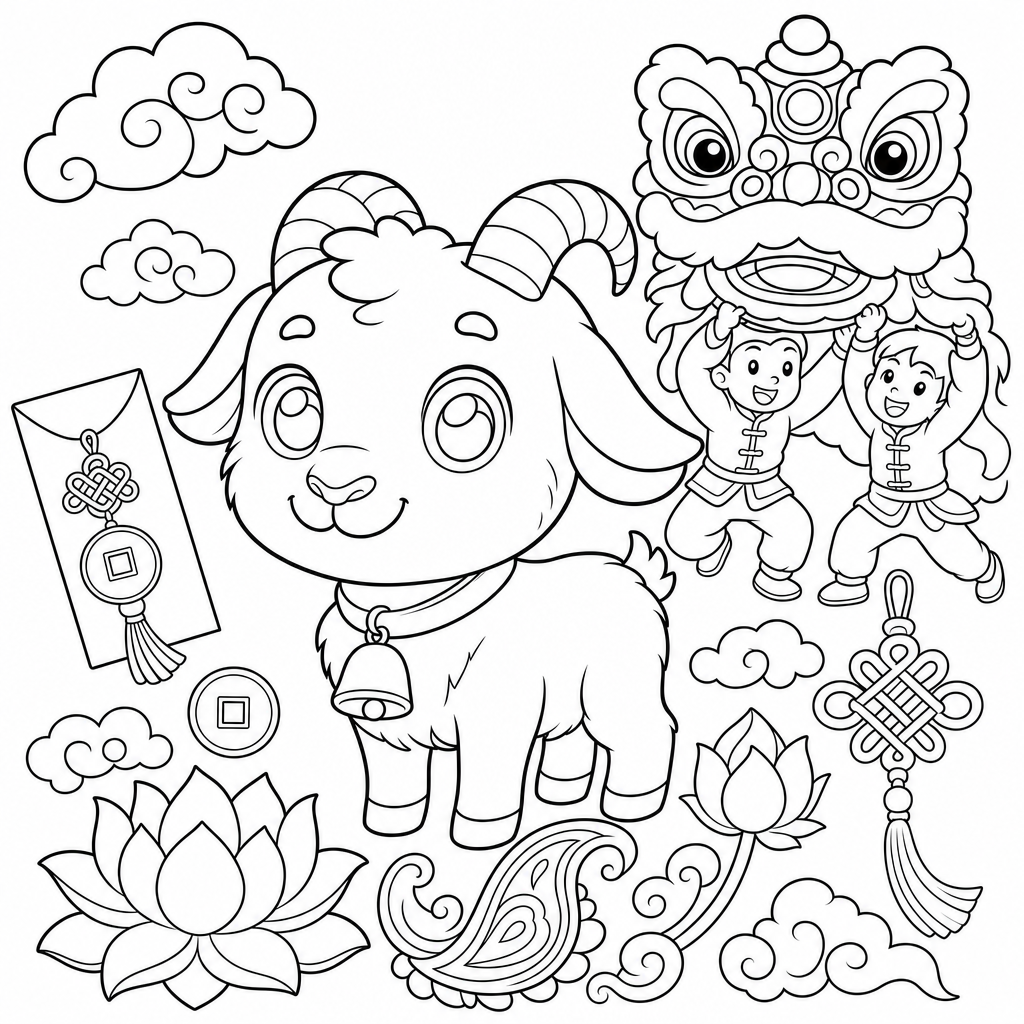
Year of the Goat (2027)
Free printable Lunar New Year 2027 coloring pages for kids with Year of the Goat, red envelope, and lion dance line art.
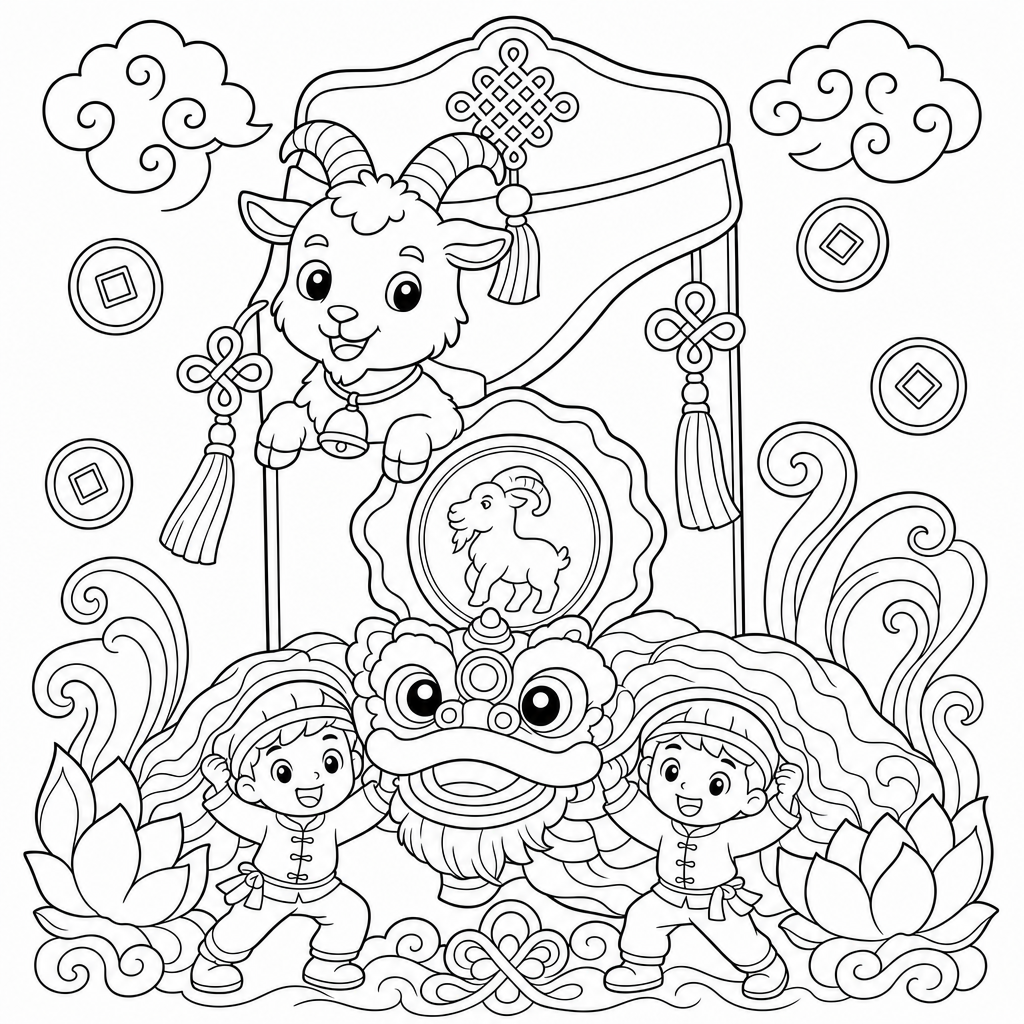
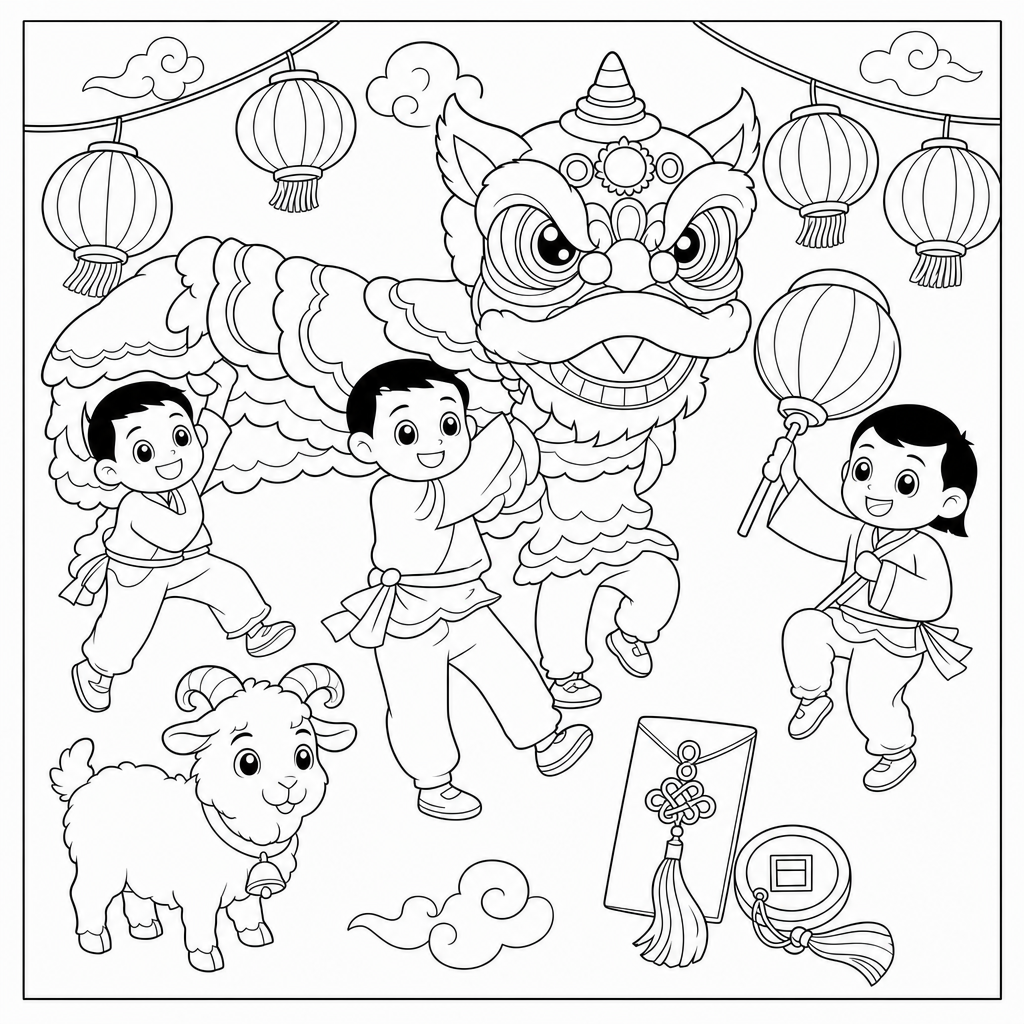
Three printable Lunar New Year 2027 coloring pages to start: a friendly Year of the Goat zodiac animal, a traditional red envelope (hongbao) with a gold coin and tassel, and a Cantonese-style lion dance head. Every page is hand-drawn line art, sized 8.5×11 at 300 DPI, optimized for crayons, markers, or colored pencils. Pages download instantly — no email signup, no ads, no spam.
Lunar New Year — 春节 Chūnjié (Chinese), Tết Nguyên Đán (Vietnamese), 설날 Seollal (Korean), Tsagaan Sar (Mongolian), Losar (Tibetan) — is the most important festival of the year across East and Southeast Asia and the Asian diaspora worldwide. It marks the first new moon of the lunisolar calendar and the official start of spring. In 2027, the new year falls on Saturday, February 6, ushering in the Year of the Goat (also called Sheep or Ram). The full celebration runs 15 days, from New Year’s Eve through the Lantern Festival on Friday, February 20, 2027.
If you’re an Asian-American parent (or any parent in a household that celebrates Lunar New Year), these coloring pages are a small daily entry point into the festival. Color the red envelope page in the weeks leading up to Feb 6, hang it on the fridge as the family decorates. Color the lion dance page the day-of, then bring your kid to a real parade in Chinatown or your local temple plaza. Color the Year of the Goat page during the long 15-day celebration, especially if your kid (or someone they love) was born in a goat year — 2015, 2003, 1991, 1979, 1967, 1955. Heritage isn’t a single big moment; it’s hundreds of small ones over years, and a coloring page on the fridge is one of the easiest small moments to create.
Lunar New Year has more visual iconography than almost any other festival on the calendar — dragons, lions, lanterns, red envelopes, fireworks, dumplings, longevity noodles, zodiac animals, peach blossoms, kumquat trees, paper-cut window decorations, calligraphy couplets, gods of fortune, the eight immortals, lion dancers, dragon dancers, drummers, fire performers. We picked the three with the strongest signal for kids:
Between these three, a kid who finishes all of them will have absorbed the visual core of the festival — animal, blessing, celebration. Expansion pages (dragon dance, dumplings, longevity noodles, firecrackers, the zodiac wheel, individual zodiac animals for other birth years) are next in the queue and will land in the months leading up to Feb 6, 2027.
A lot of Asian-American kids grow up adjacent to Lunar New Year but not fully in it. They know “we celebrate Chinese New Year” (or Tết, or Seollal), they get a red envelope from grandma once a year, they eat a special dinner, and that’s the whole experience. The depth of the festival — the 15-day arc, the daily rituals, the zodiac mythology, the regional foods and superstitions — doesn’t quite land, because there’s no daily touchpoint between February of one year and February of the next.
Coloring pages aren’t a complete solution, but they’re a real one. A red envelope taped to the fridge for the three weeks before Lunar New Year means a kid sees that symbol every morning at breakfast, every afternoon when they get home from school. By the time the actual red envelope arrives in their hands on Feb 6, the symbol is familiar — and familiarity is half of cultural fluency. The other half is doing the thing in real life, and the coloring page is a clean bridge to “let’s go to the lion dance parade together this weekend.”
This is why mamaki exists. Asian-American families deserve coloring content that’s actually researched (not generic “oriental” filler from a stock-image factory), and we’re slowly building out the catalog so every major festival has at least three solid pages on it: Lunar New Year in January or February, Mid-Autumn Festival in September or October, Diwali in October or November, plus heritage-language flashcards (hiragana, pinyin), heritage food (boba, sushi, dumplings), and heritage scripts as they’re added.
The shapes are intentionally clean and the fill areas generous. Kids can extend each page with their own touches: add gold coins floating around the red envelope, draw firecrackers bursting behind the lion dance head, or write the names of family members in a small heart next to the goat.
Here’s the version of the Lunar New Year origin story to tell your kid while they color. The most widely told version is the legend of Nian (年, literally “year”):
Long ago in ancient China, there was a terrifying beast named Nian. Once a year, on the last night of winter, Nian would come down from the mountains (or up from the sea, depending on the version) and attack villages — eating livestock, crops, and sometimes children. For generations, families would flee to the mountains on the night Nian was due to arrive, abandoning their homes and praying the beast wouldn’t follow.
One year, an old beggar arrived at a village just as the families were packing to flee. He asked an old woman for food and shelter, and in exchange he promised to chase Nian away. The villagers thought he was crazy — but the old woman agreed.
That night, the beggar covered the woman’s doors and windows with red paper, lit bright lanterns throughout the house, and set off firecrackers in the courtyard. When Nian arrived, the beast was terrified by the color red, the bright light, and the loud noise. Nian fled and never returned.
When the villagers came back the next morning and saw the houses still standing, they realized the old beggar had been a god in disguise. From that day onward, every year on the same night, families have lit red lanterns, hung red couplets, set off firecrackers, and worn red clothes — to chase away Nian and welcome the new year safely.
That’s why everything at Lunar New Year is red, loud, and bright. The red envelopes? Red because of Nian. The firecrackers? Loud because of Nian. The lion dance with its drums and cymbals? Loud and visually overwhelming because of Nian. Even the word for “year” in Chinese is the name of the beast — every year is a year you successfully chased the beast away.
For a four-year-old, the Nian story is perfect. For an older kid, you can layer in the zodiac (each year is named for an animal that won a race in the Jade Emperor’s mythology — that’s a separate story worth a whole different evening), the Kitchen God who returns to heaven on the 23rd day of the 12th lunar month to report on each family’s behavior, the Lantern Festival on Day 15 that closes out the celebration, and the regional variations across China, Vietnam, Korea, Mongolia, and Tibet.
In the 12-year Chinese zodiac, each year is assigned an animal: Rat, Ox, Tiger, Rabbit, Dragon, Snake, Horse, Goat, Monkey, Rooster, Dog, Pig. The Goat (羊 yáng — also translated as Sheep or Ram, depending on regional preference) is the eighth animal. The most recent goat years were:
Goats in Chinese astrology are known for being calm, creative, gentle, family-oriented, and a little stubborn underneath the soft exterior. They’re the artists of the zodiac — sensitive to beauty, patient with detail, drawn to peaceful environments. Famous people born in goat years include Steve Jobs (1955), Mark Zuckerberg (1984 — but that’s a rat year actually; we’re checking — yes 1984 is a rat year), Julia Roberts (1967), Bruce Willis (1955), Pamela Anderson (1967), and many others. (Zodiac compatibility is a whole separate fun rabbit hole — goats traditionally pair best with rabbits and pigs, and clash most with oxen and dogs.)
Even if your kid isn’t a goat themselves, knowing the year’s animal is a small but real way to participate. Greet other families with “Year of the Goat” wishes, point out goats in storybooks and zoos with extra excitement, and watch for goat-themed decorations, stamps, and red envelopes through the celebration — every Lunar New Year, the zodiac animal of the year shows up everywhere, briefly, before passing the baton to the next animal.
Lunar New Year is one of the most visually exciting festivals on the calendar — full stop. Most American kids’ default frame for “festival” is Halloween, Christmas, or Easter, all of which have a fairly limited palette. Lunar New Year blows the color budget wide open: deep red, fire orange, hot yellow, gold leaf, jewel green, sky blue (especially for the goat year — blue is associated with calm goat energy), white, and pink. Every page can use ten different colors and still feel coherent.
The visual density is also forgiving. A red envelope is a rectangle with a coin — kids can color it any way they want and it still looks like a red envelope. A goat is a friendly fluffy animal — even a wonky goat reads as a goat. A lion dance head is so visually distinctive (the big eyes, the swirling mane, the pom poms) that even a five-year-old can produce something recognizable. There’s no anatomy to get wrong, no perspective to mess up.
This makes Lunar New Year coloring pages especially good for mixed-age sibling sessions. A four-year-old can color the red envelope in five minutes flat with chunky crayons. An eight-year-old can color the goat with markers, layering a red ribbon and gold bell for half an hour, and feel proud of the result. A ten-year-old can color the lion dance head with colored pencils, add subtle gradient shading on the mane, layer in fine pom pom detail, and produce something legitimately beautiful. Same set of pages, three different attention spans, three different outcomes — all of them on the fridge.
For preschoolers and kindergarteners, start with the red envelope page. The shapes are big, the fill areas are obvious, and there’s no way to mess it up. Hand them three crayons — red, gold, yellow — and let them go. The first time they finish, they’ll want to do another one. Print the page twice and let them experiment with different color combinations (some families switch to a pink envelope for the bride at a wedding, or to a white envelope for funerals — pink and white envelopes are an easy variation kids can try).
For this age, the Year of the Goat page also works well if you treat it like a free-paint surface rather than a precise coloring activity. Don’t worry about realistic goat coloring (most actual goats are brown, white, or black, but kids will absolutely want a rainbow goat) — let the four-year-old put whatever colors they want anywhere. The result looks like a kindergarten art-show piece, which is exactly the right vibe.
This is the sweet spot for the lion dance page. Six- to nine-year-olds love bold expressive characters, they can stay inside the lines reliably, and they enjoy the puzzle of “how do I color this so the lion looks lucky?” Give them a set of markers in the full LNY palette (red, orange, yellow, gold, green, blue, pink) and they’ll spend thirty to forty minutes on this page.
The Year of the Goat also works for this age. Some kids will go realistic (cream body, brown horns, golden bell), some will go wild (rainbow goat, sparkly goat, all-purple goat) — both are fine. The goal is engagement with the zodiac concept, not zoological accuracy.
For older kids who can sit with a single page for an hour, the lion dance is the page to lean into. Use colored pencils. Encourage gradient shading on the mane (orange swirling into red into deeper red), highlight detail on the pom poms (pink in the center, deeper pink on the edges), and add a layered pattern on the ear flaps (gold over yellow, alternating triangles).
This is also the age where the storytelling around the pages starts to land. Tell them the Nian legend while they color the lion. Tell them the Jade Emperor’s zodiac race story while they color the goat — how the rat tricked the ox into giving him a ride and won first place by jumping off the ox’s head at the finish line, how the cat was tricked by the rat into missing the race entirely (which is why there’s no cat in the Chinese zodiac, but there is a cat in the Vietnamese zodiac), how the goat came in 8th because she got tangled in a river current with the monkey and the rooster. Older kids genuinely engage with mythology, and the coloring page is a low-pressure setting to absorb a story.
Coloring pages work best as part of a small, repeatable Lunar New Year ritual the family does together. Here’s one structure that works:
This is the minimum-viable Lunar New Year ritual for a family that doesn’t have a deep daily-practice Chinese (or Vietnamese, or Korean) home life — and it’s enough. Years of small rituals add up. By the time the kid is in middle school, Lunar New Year means something to them, not because they were taught a definition but because every late January or early February they did the same warm sequence of actions with their parents.
Lunar New Year is celebrated under different names across East and Southeast Asia. If your family is from any of these traditions, or you have classmates and friends who are, here’s a quick reference so you can be a good neighbor about all of them:
Chinese — Spring Festival (春节, Chūnjié)
Vietnamese — Tết Nguyên Đán (often just Tết)
Korean — Seollal (설날)
Mongolian — Tsagaan Sar (Цагаан сар, “White Moon”)
Tibetan — Losar (ལོ་གསར་)
If your kid’s classroom has families from any of these traditions, knowing the right greeting and a basic fact or two is a small but real way to honor each culture as its own. Lunar New Year isn’t a single homogenous “Asian holiday” — it’s a family of related celebrations that share a lunisolar root.
This page will grow through the second half of 2026 and into early 2027. Next batch will add a dragon dance scene (the long flexible dragon with many performers, perfect for kids who want a big complex page), a dumpling and longevity noodles spread (the New Year dinner table, the food kids actually associate with the celebration), a firecracker and lantern night scene (the loud bright energy of LNY night), a zodiac wheel page (all 12 animals arranged in a circle around a central yin-yang or family-name center), and individual zodiac animal pages for kids whose birth year falls on a different animal (Dragon, Tiger, Rabbit, and others — these matter to families because they want a page for their actual zodiac).
We’re also planning a longer-form Lunar New Year activity mega-bundle — a printable parent-and-kid PDF that combines the line-art pages with:
This will be the largest paid bundle in the heritage lane (alongside the Mid-Autumn and Diwali bundles already in production) — a small revenue source that helps keep the rest of mamaki.fun free for everyone. If you’d like to be notified when the bundle launches in December 2026 (in time for January / February 2027), drop us a note on Pinterest or Twitter and we’ll let you know.
If there’s a specific Lunar New Year image your family wants — a regional variation, a specific deity, a Vietnamese-style Tết scene, a Korean-style Seollal scene with hanbok, a Mongolian-style Tsagaan Sar scene with buuz — request it on our Pinterest and we’ll prioritize. We watch which requests come in and ship the most-asked-for ones first.
A few extra questions that come up from parents and teachers using these pages:
Why is it called “Lunar New Year” and not “Chinese New Year”? Both are correct depending on context. “Chinese New Year” is accurate when describing the Chinese tradition specifically. “Lunar New Year” is the inclusive umbrella term that also covers Vietnamese Tết, Korean Seollal, Mongolian Tsagaan Sar, and other lunisolar new year celebrations across Asia. In US schools and public events, “Lunar New Year” is increasingly preferred because it’s welcoming to all the cultures that celebrate it, not just one. If you’re at a Chinese friend’s home celebration, “Chinese New Year” is great. At a school assembly with families from multiple Asian backgrounds, “Lunar New Year” is the right framing.
Is the date always different from January 1? Yes. The Lunar New Year is based on a lunisolar calendar, not the Gregorian calendar. The Gregorian date moves between late January and mid-February each year, anchored to the second new moon after the winter solstice. In 2025 LNY was Jan 29, in 2026 Feb 17, in 2027 Feb 6, in 2028 Jan 26, in 2029 Feb 13, in 2030 Feb 3.
How long does Lunar New Year actually last? The full traditional Chinese celebration is 15 days, from New Year’s Eve through the Lantern Festival. Day 1 is the big family reunion dinner and red envelope distribution. Days 2–5 are visiting extended family and friends. Day 7 (Renri, “Everybody’s Birthday”) is a smaller observance where everyone’s age increases by one (in traditional Chinese reckoning). Day 8–14 are quieter visiting and rest days. Day 15 is the Lantern Festival — the formal close, with lantern displays, tangyuan, and the first full moon of the lunar year. In modern China the official public holiday is 7 days; in Vietnam it’s 5–7 days; in Korea it’s 3 days; in most of the diaspora it’s whatever weekend the family can gather.
Are firecrackers a real part of it? Yes, traditionally — though banned in many cities due to noise and fire safety. The mythological origin is chasing away Nian (the beast in the legend) with loud noise. Practically, kids in many countries see firecrackers at street parades, restaurant openings, and family courtyards during the celebration. If your family doesn’t do real firecrackers, “popper” party favors or just clapping and shouting are kid-friendly substitutes for the noise tradition.
Can non-Asian families celebrate Lunar New Year? Yes — Lunar New Year is a welcoming festival, and many non-Asian families in the US celebrate it with Asian-American friends, at school cultural-night events, or as part of their own broader interest in world cultures. If you’re new to Lunar New Year, the friendly entry point is exactly what these pages encourage: print some red decorations, eat dumplings together, learn the greeting, watch a lion dance video, give your kids a small red envelope with a coin in it. No cultural appropriation worry — it’s a festival of family, blessing, and the start of spring, and these are universal human themes that travel well across cultures when approached with respect.
My kid was born in January or early February — what zodiac animal are they? Check carefully. The Chinese zodiac year changes on Lunar New Year, not on Gregorian January 1. So a baby born on January 28, 2025 (before LNY 2025 on Jan 29) is a Dragon (the 2024 animal), not a Snake. A baby born on January 30, 2025 is a Snake. The same logic applies every year. If your kid’s birthday falls in late January or early February, look up the exact LNY date of their birth year to confirm which zodiac animal they actually are.
These coloring pages are free for personal, classroom, library, home-school, temple, community-center, and birthday-party use. They’re fan-made hand-drawn line art and not affiliated with any official organization. Please don’t resell them or claim them as your own — but printing as many copies as you need for kids, friends, family, and classmates is entirely fine.
If you share photos of finished pages on social media, tag us — we love seeing what kids do with them.
Happy Lunar New Year. Xīn nián kuài lè. Chúc mừng năm mới. Saehae bok mani badeuseyo. Welcome to the Year of the Goat.
Instant-download a 25-page printable pack, or gift the custom storybook bundle starring your kid plus a matching printed coloring pack.