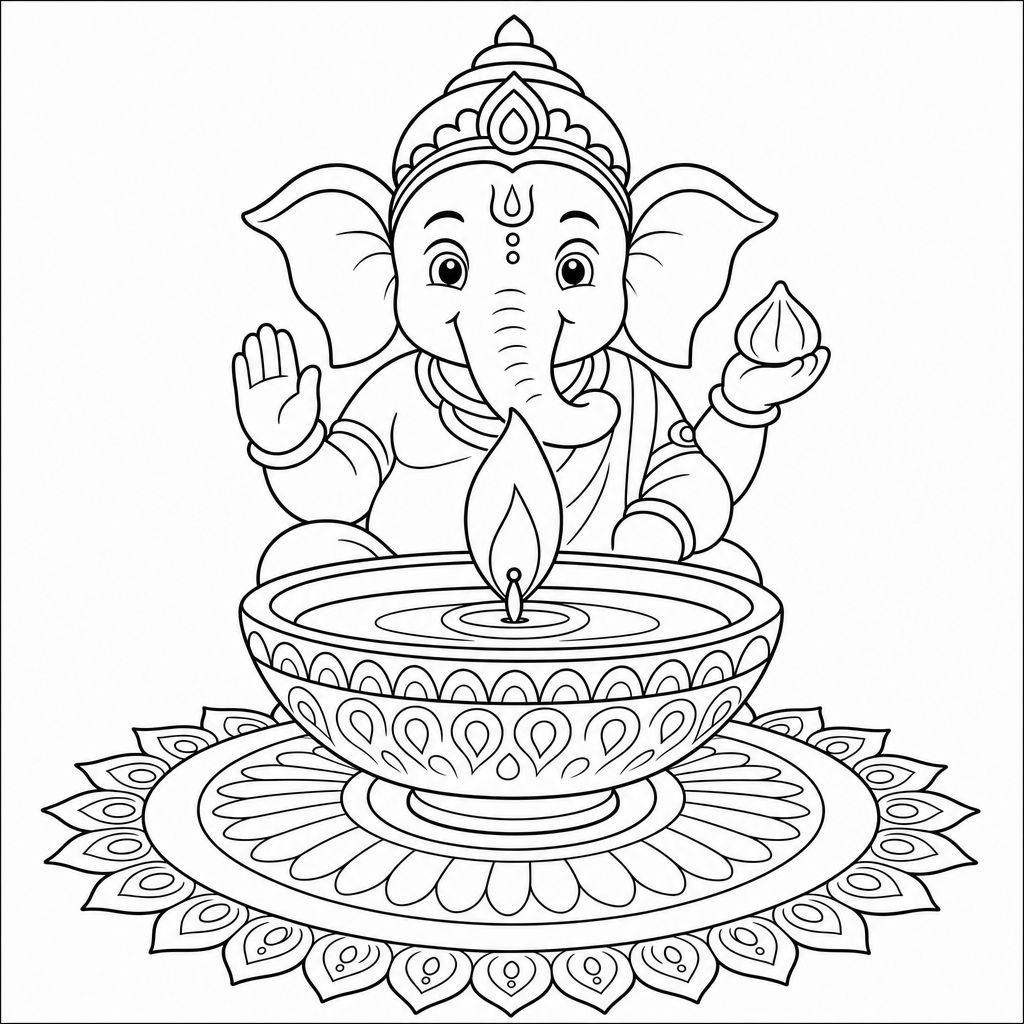
Diya (oil lamp)
Free printable Diwali coloring pages for kids with a diya oil lamp, rangoli pattern, and Ganesha in researched hand-drawn line art.
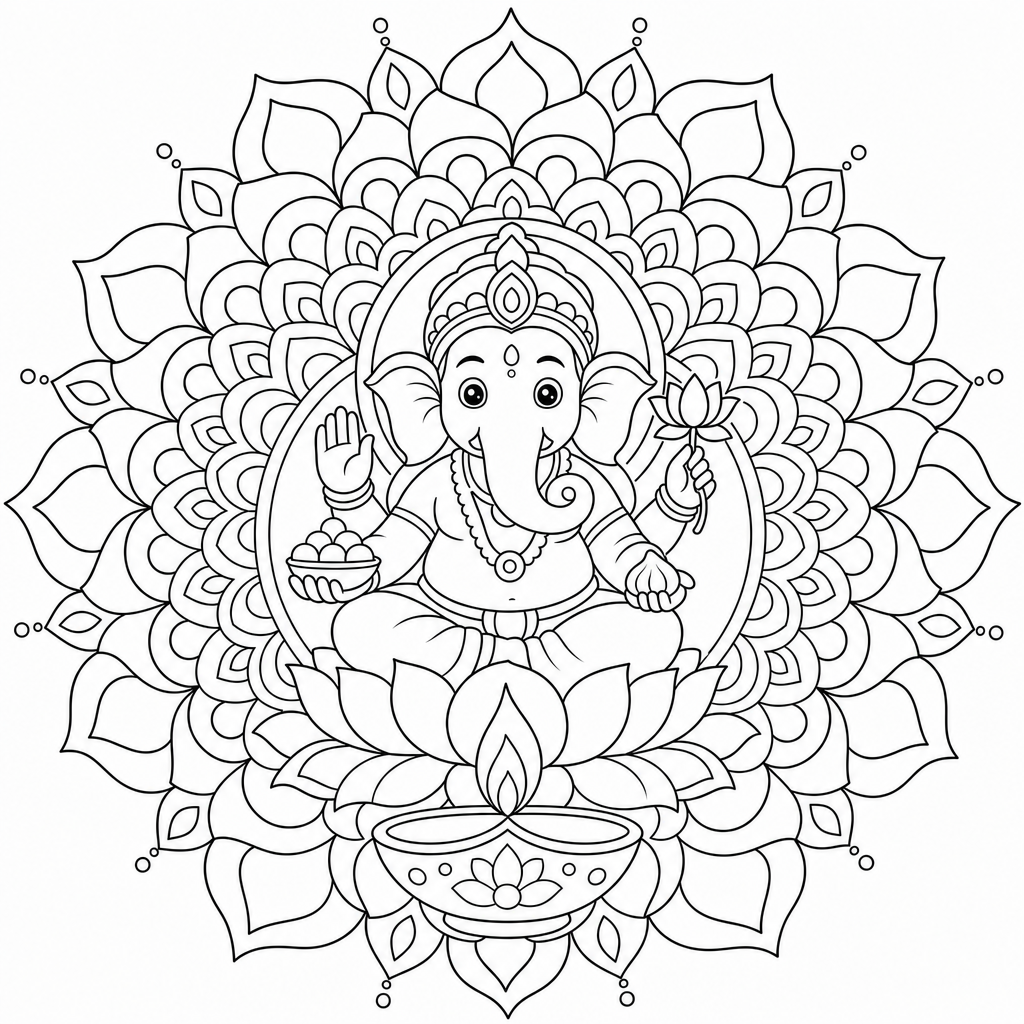
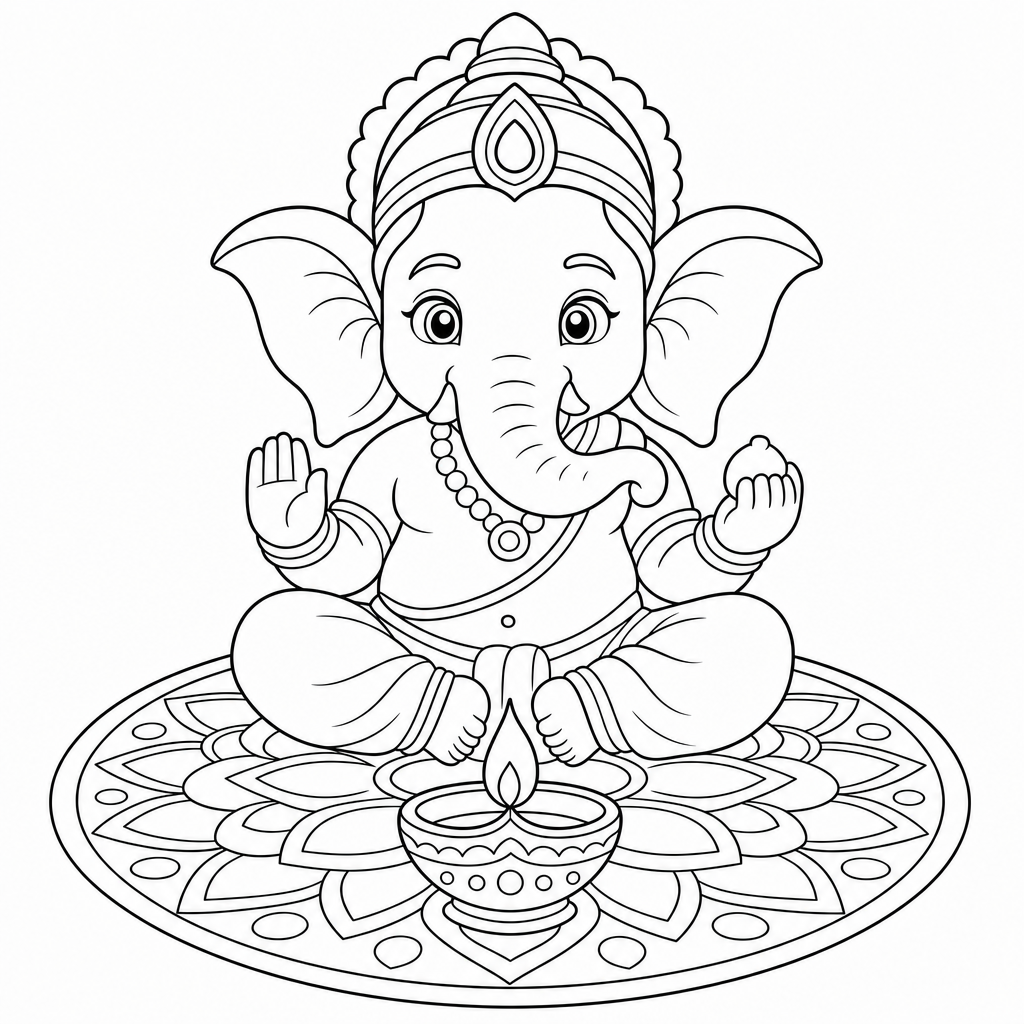
Three printable Diwali coloring pages to start: a clay diya oil lamp with a tall flame, a symmetric circular rangoli floor pattern, and Ganesha the elephant-headed deity sitting in lotus position. Every page is hand-drawn line art, sized 8.5×11 at 300 DPI, optimized for crayons, markers, or colored pencils. Pages download instantly — no email signup, no ads, no spam.
Diwali — Deepavali in Sanskrit, literally “row of lamps” — is the biggest festival in the Hindu calendar and one of the most widely celebrated holidays in the world. It lights up homes across India, the United States, Canada, the UK, Singapore, Malaysia, Australia, the UAE, Trinidad, Mauritius, Fiji, and anywhere else there’s a meaningful Hindu, Sikh, Jain, or Buddhist community. In 2026 the main night of Diwali falls on Sunday, November 8 — the new moon of the Hindu month of Kartik.
If you’re an Indian-American parent (or any parent in a household that celebrates Diwali), these coloring pages are a small daily entry point into the festival. Color the diya page in late October as the festival approaches. Color the rangoli page the day-of, then sketch a real rangoli at your front door together. Color the Ganesha page the evening of Diwali itself, before or after the family does its Lakshmi-Ganesha puja. Heritage doesn’t get passed down in a single big moment — it gets passed down through hundreds of small ones over years, and a coloring page on the fridge is one of the easiest small moments to create.
Diwali has a lot of imagery — diyas, rangolis, fireworks, sweets, Lakshmi, Ganesha, Rama and Sita returning to Ayodhya, the asura Naraka being defeated by Krishna, the demoness Holika burning in the bonfire, golden marigold garlands, sparklers, gold coins, mehndi henna patterns. We picked the three with the strongest signal for kids:
Between these three, a kid who finishes all of them will have absorbed the visual core of the festival — light, color, and welcome. Expansion pages (Lakshmi, fireworks, string of diyas, a kid lighting a phuljhari) are next in the queue and will land in the coming weeks based on which page gets the most Pinterest activity.
A lot of Indian-American kids grow up adjacent to Diwali but not fully in it. They know “we celebrate Diwali,” they wear new clothes once a year, eat the sweets their parents bring home, light a sparkler in the driveway, and that’s the whole experience. The depth of the festival — the Lakshmi puja, the Ramayana story, the regional variations from Bengali Kali Puja to Gujarati New Year — doesn’t quite land because there’s no daily touchpoint between November of one year and November of the next.
Coloring pages aren’t a complete solution, but they’re a real one. A diya page taped to the fridge for the three weeks before Diwali means a kid sees that lamp every morning at breakfast, every afternoon when they get home from school. By the time the festival actually arrives, the image is familiar — and familiarity is half of cultural fluency. The other half is doing the thing in real life, and the coloring page is a clean bridge to “let’s go light a real diya together tonight.”
This is why mamaki exists. Indian-American families deserve coloring content that’s actually researched (not “ethnic” filler made by a generic stock-image factory), and we’re slowly building out the catalog so every major festival has at least three solid pages on it: Diwali in November, Holi in March, Dussehra and Navratri in autumn, Raksha Bandhan in August, Janmashtami in late summer, Onam in early fall, Pongal and Sankranti in mid-January.
The shapes are intentionally clean and the fill areas generous. Kids can extend each page with their own touches: add fireworks bursting in the sky around the diya, write the names of family members along the rangoli border, or draw a small mouse (Ganesha’s vahana, his animal mount) at his feet.
Here’s the version of the Diwali story to tell your kid while they color. Each region of India has slightly different mythological framing, but the most widely told version is this:
Long ago in the kingdom of Ayodhya, there lived a prince named Rama, his wife Sita, and his loyal younger brother Lakshmana. Through palace politics, Rama was unjustly exiled into the forest for fourteen years. Sita and Lakshmana refused to let him go alone — they walked into exile beside him.
During the exile, the demon king Ravana kidnapped Sita and carried her across the sea to his island kingdom of Lanka. Rama, Lakshmana, and an army of monkeys led by the loyal Hanuman (yes — the monkey god, who can carry mountains and leap across oceans) marched all the way to Lanka, fought Ravana, and rescued Sita. Good defeated evil.
On the night Rama, Sita, and Lakshmana returned home to Ayodhya — fourteen years after they had left — the people of the city lit small clay lamps along every street, every doorway, and every windowsill to welcome them home. Rows and rows of tiny lights, on a moonless night, guiding the royal family back to the throne. That is Diwali — Deepavali, “row of lamps.”
That’s the headline version. There are other Diwali origin stories too: in some traditions Diwali commemorates Krishna defeating the demon Narakasura; in Bengal the festival is Kali Puja, honoring the goddess Kali; for Jains it marks the moment Mahavira attained nirvana; for Sikhs it celebrates the release of Guru Hargobind from imprisonment. The lights and the celebration mean different things to different communities — but the universal idea is the same: light wins over darkness.
For a four-year-old, the headline version is plenty. For an older kid, you can add a layer per year — first year, just the lights and the welcome-home. Second year, add Ravana and the rescue. Third year, add Hanuman and the monkey army. By the time your kid is ten, they’ll know the whole Ramayana — not from a textbook, but from a story told over Diwali coloring pages.
Diwali is one of the most visually exciting festivals on the calendar — full stop. Most American kids’ default frame for “festival” is Halloween or Christmas, both of which have a fairly limited palette (orange-black for one, red-green-white for the other). Diwali blows the color budget wide open: marigold yellow, deep crimson red, gold leaf, hot pink, lotus pink, terracotta orange, sapphire blue, jewel green, henna brown. Every page can use ten different colors and still feel coherent.
The visual density is also forgiving. A diya is just a lamp — kids can color it any way they want and it still looks like a diya. A rangoli is symmetric — even a five-year-old who can’t draw straight lines can make their rangoli look “right” because the pattern does the work. Ganesha is so iconic that even a wonky elephant head still reads as Ganesha. There’s no anatomy to get wrong, no perspective to mess up.
This makes Diwali coloring pages especially good for mixed-age sibling sessions. A four-year-old can color the diya in five minutes flat with chunky crayons. An eight-year-old can color the rangoli with markers for half an hour and feel proud of the result. A ten-year-old can color Ganesha with colored pencils, add gradient shading on the skin and crown, and produce something legitimately beautiful. Same set of pages, three different attention spans, three different outcomes — all of them on the fridge.
For preschoolers and kindergarteners, start with the diya page. The shapes are big, the fill areas are obvious, and there’s no way to mess it up. Hand them three crayons — orange, yellow, red — and let them go. The first time they finish, they’ll want to do another one. Print the page twice and let them experiment with different color combinations.
For this age, the rangoli page also works well if you treat it like a free-paint surface rather than a precise coloring activity. Don’t worry about the symmetry — let the four-year-old put random colors in random petals. The result looks like a kindergarten art-show piece, which is exactly the right vibe.
This is the sweet spot for the rangoli page. Six- to nine-year-olds love symmetric patterns, they can stay inside the lines reliably, and they enjoy the small puzzle of “how do I color this so the petals look like a real rangoli?” Give them a set of markers in the full Diwali palette (red, orange, yellow, pink, green, blue, gold) and they’ll spend thirty to forty minutes on this page.
Ganesha also works for this age. Some kids will go realistic (pink skin, gold crown, green throne), some will go wild (rainbow Ganesha, sparkly Ganesha, all-purple Ganesha) — both are fine. The goal is engagement with the figure, not religious accuracy.
For older kids who can sit with a single page for an hour, Ganesha is the page to lean into. Use colored pencils. Encourage gradient shading on the skin (light pink in the center, deeper pink at the edges), highlight detail on the crown and jewelry (gold pencil over yellow pencil), and a layered lotus throne (pink petals at the top, deeper pink underneath, green leaves at the base).
This is also the age where the storytelling around the pages starts to land. Tell them the Ramayana story while they color Ganesha. Tell them why Ganesha is invoked first in any Hindu ritual (he’s the remover of obstacles — you start every new beginning by asking Ganesha to clear the path). Older kids genuinely engage with mythology, and the coloring page is a low-pressure setting to absorb a story.
Coloring pages work best as part of a small, repeatable Diwali ritual the family does together. Here’s one structure that works:
This is the minimum-viable Diwali ritual for a family that doesn’t have a deep daily-practice Hindu home life — and it’s enough. Years of small rituals add up. By the time the kid is in middle school, Diwali means something to them, not because they were taught a definition but because every November they did the same warm sequence of actions with their parents.
This page will grow. Next batch will add Lakshmi, the goddess of wealth and prosperity, who is welcomed into the home on Diwali night (with the canonical iconography — four arms, lotus flowers, gold coins flowing from her palm). After Lakshmi we’ll release a fireworks-and-sparkler scene — a kid in pajamas holding a phuljhari sparkler in the front yard, with rocket fireworks in the sky behind them, the wholesome Diwali-night memory every desi adult still carries. After that, a string of diyas for the kid who loves repeating decorative patterns, and a Diwali home-decoration scene with marigold garlands, string lights, sweets on a plate, and a small Lakshmi-Ganesha shrine.
We’re also planning a longer-form Diwali activity bundle — a printable parent-and-kid PDF that combines the line-art pages with a one-page parent guide (the myth, the regional variations, the puja steps for families who want to do one), a printable recipe card for ladoo or jalebi, and a “decorate-your-own-rangoli” worksheet for kids to design their own pattern. This will be the first paid bundle on the heritage lane (alongside the planned Mid-Autumn and Lunar New Year bundles) — a small revenue source that helps keep the rest of mamaki.fun free.
If there’s a specific Diwali image your family wants — a regional variation, a specific deity, a Bengali Kali Puja page, a Jain Mahavira nirvana page, a Sikh Bandi Chhor Divas page — request it on our Pinterest and we’ll prioritize. We watch which requests come in and ship the most-asked-for ones first.
A few extra questions that come up from parents and teachers using these pages:
Is Diwali only a Hindu festival? No. Diwali is celebrated by Hindus, Sikhs, Jains, and Buddhists, each for slightly different historical and spiritual reasons. The Sikh community calls it Bandi Chhor Divas (“Day of Liberation”) and commemorates the release of the sixth Sikh guru, Guru Hargobind, from imprisonment in Gwalior Fort in 1619 — he refused to leave unless 52 other unjustly imprisoned princes were freed with him. The Jain community marks Diwali as the day Lord Mahavira attained nirvana in 527 BCE. Newar Buddhists in Nepal celebrate Diwali as Swanti with a sequence of pujas, including a special day honoring dogs (Kukur Tihar — the day every dog in town gets a flower garland). The festival belongs to many traditions, and the lights are common ground.
Is it pronounced “DEE-wah-lee” or “duh-WAH-lee”? The Sanskrit/Hindi pronunciation is closest to dee-VAH-lee (with a soft “v” sound and equal stress on the second syllable). Americans often say “duh-WAH-lee” — that’s fine, everyone will know what you mean. The full Sanskrit name is Deepavali (दीपावली), literally “row of lamps.”
How long does Diwali last? Five days. Day 1 is Dhanteras (cleaning the house, buying new utensils or gold). Day 2 is Naraka Chaturdashi / Choti Diwali (smaller-scale Diwali, lamps lit at home). Day 3 is Diwali proper — the big day, the new moon night, the Lakshmi-Ganesha puja, the fireworks, the family dinner. Day 4 is Govardhan Puja / Annakut — honoring the day Lord Krishna lifted Mount Govardhan to shield the village from a storm; many merchant families also start their new financial year. Day 5 is Bhai Dooj — sisters and brothers honor each other, similar to Raksha Bandhan in August.
Are fireworks really a big part of Diwali? Yes, traditionally — but practices are changing. Diwali fireworks are loud, polluting, and unsafe for pets and people with respiratory conditions. Many Indian cities now limit fireworks to two hours on Diwali night, and a growing number of families have switched to small sparklers (phuljhari) and decorative lights only. If your kid is sensitive to noise or you have pets, you can absolutely celebrate Diwali without big fireworks — the diyas, the rangoli, the food, and the family gathering are the heart of it.
Can non-Indian families celebrate Diwali? Yes — Diwali is a welcoming festival, and many non-Indian families in the US celebrate it with Indian-American friends, at school cultural-night events, or as part of their own broader interest in world religions and traditions. If you’re new to Diwali, the friendly entry point is exactly what these pages encourage: light some candles or diyas at home, draw a rangoli with chalk on the front step, eat some Indian sweets, and tell the kids the Ramayana story. No religious obligation, no appropriation worry — it’s a festival of lights, and lights are for everyone.
These coloring pages are free for personal, classroom, library, home-school, temple, community-center, and birthday-party use. They’re fan-made hand-drawn line art and not affiliated with any official organization. Please don’t resell them or claim them as your own — but printing as many copies as you need for kids, friends, family, and classmates is entirely fine.
If you share photos of finished pages on social media, tag us — we love seeing what kids do with them.
Happy Diwali. Light wins.
Instant-download a 25-page printable pack, or gift the custom storybook bundle starring your kid plus a matching printed coloring pack.